
A vessel is a design job first, but our production experts work alongside the design from start to finish.
A tank has to hold its contents, survive an earthquake, clean itself between runs, fit on a truck, and land square on a plinth that was poured months earlier. Get those right on paper and the fabrication is straightforward. Get one wrong and you find out on site.
So our engineers start with your process. How the product behaves, what pressure and vacuum the vessel will see, how it gets cleaned, how often it’s opened, and what the site will allow through the gate. Then we size the strakes, set the wall thickness, add the reinforcement, and draw a vessel that can actually be built and delivered.
We’ve been making tanks and silos for dairy, food, beverage and water since 1992 — from 1m³ balance tanks up to large product silos. One team collaborates to design, fabricate, test, transport and install.
Balance tanks, buffer and surge tanks, day tanks and bulk storage. Sloped or cone floors, full drainage and the fittings your plant already uses.
Mixing, blending and holding vessels with dimple jackets, insulation, agitator mounts and the nozzle set your process drawing calls for.
Vertical silos for milk, cream, chilled water and bulk product. Insulated, clad, and designed for the seismic duty.
Powder hoppers, bins and bulk dry handling vessels with the cone angle set for the product’s flow behaviour, and fluidising or aeration built in.
CIP sets, chemical dosing and storage, and rinse recovery tanks with material grade matched to chemical and temperature.
Pressure filter vessels, batch and flocculation tanks, vortex, permeate and clarifier components for water and wastewater treatment plants.
01
Design and review
We work through your process duty, agree the standard and the loadings, model the vessel, and settle the inspection plan with you before we begin.
02
Fabricate
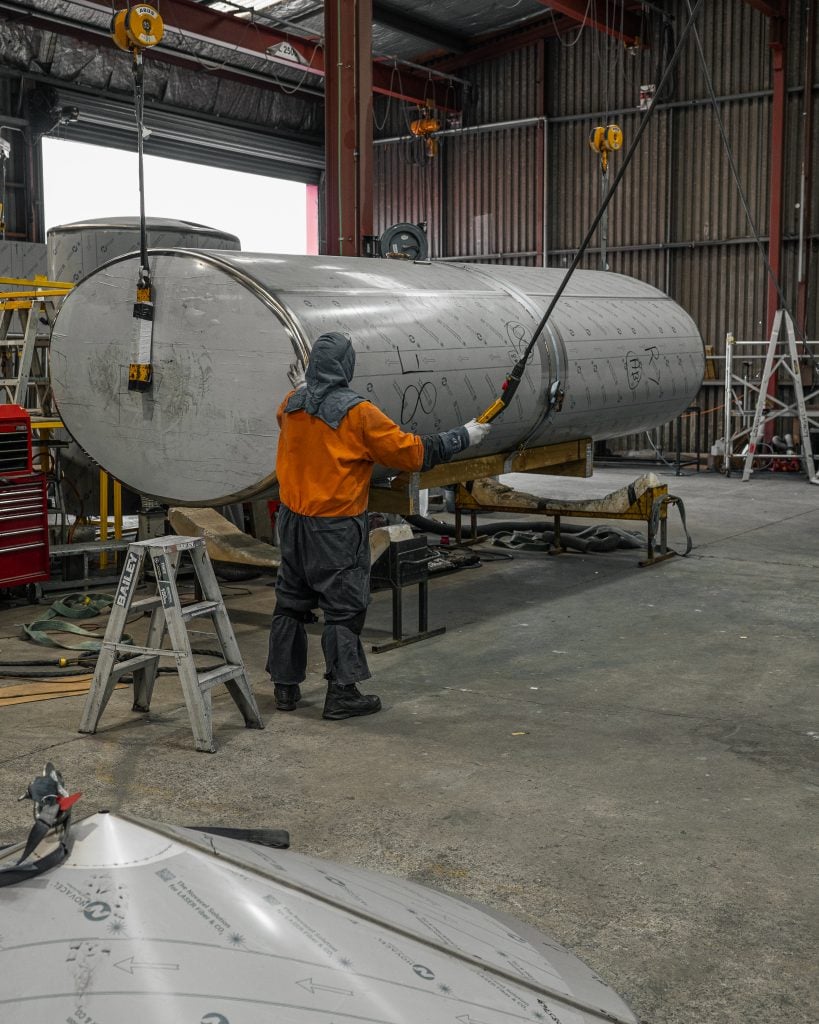
We check mill certificates, log the heats, roll and form the strakes, and weld to qualified procedures with in-process checks against the plan.
03
Finish and test
We dress and polish the internals, pickle and passivate, then inspect, pressure test and record the finish before anything leaves the floor.
04
Deliver and install
We survey the route, move the vessel, set it on the plinth, anchor, grout and align it, and hand the documentation over with the tank.
We partner with industry leaders setting the benchmark, and innovators looking to shape something remarkable.







Before you send the process spec
The largest we’ve built in one piece is a 90m³ powder hopper, 3 metres in diameter and 14 metres long. Our standard range runs from 1m³ balance tanks up to 100m³ silos.
Give us the volume and the site address, and we’ll work out whether the vessel travels whole or gets assembled where it stands.
In New Zealand the line sits at 50 kPa gauge. Above it, the vessel is pressure equipment under the PECPR regulations: designed to a recognised standard such as AS 1210, verified by a recognised inspection body before manufacture, and inspected in service.
A lot of vessels sit close to that line, and a jacket, a blanketing gas or a vacuum case can move one across it. Put the operating and design pressures in your enquiry and we’ll confirm which regime applies.
Either. Our engineers do mechanical design in-house, working from your process duty — volumes, temperatures, pressures, product behaviour and the site constraints. We also build to a client’s or an OEM’s drawings where the design is already done.
If you’re still at the process stage, that’s the best time to talk.
Product-contact surfaces are generally held to Ra 0.8 µm or better, with internal welds ground flush and polished so nothing can sit in a crevice. MPI’s guidance for dairy premises and equipment points to 3-A hygienic design practice, and your verifier will assess the vessel through your Risk Management Programme.
We measure the finish and keep the numbers, so you have Ra readings and passivation records to put in front of a verifier.
Usually, and that constraint shapes the design. We survey the gap, the crane position and the access route first, then size the vessel to what can actually be landed — including the lift over whatever’s in the way.
Retrofits into an operating plant are a large part of what we do. Tell us when your production window opens and we’ll plan the lift around it.
We install. Site work is how Longveld started in 1992. That covers route survey and permits, arrival inspection, core drilling, anchoring, grouting, final alignment and connection.
We coordinate with the crane, the transport provider and your site team. We don’t cover civil works.
Yes through NZS 1170.5, using the NZSEE recommendations for the seismic design of storage tanks.
As-built drawings, material test certificates for the heats used, welding procedures and welder qualifications, the weld map, NDT and inspection reports, pressure or leak test records, surface finish and passivation records, and the design verification certificate where the vessel is pressure equipment.
If your auditor, verifier or consent needs something beyond that, raise it at contract review. We’ll build it into the inspection plan up front.
Need a team of problem-solving fabricators?