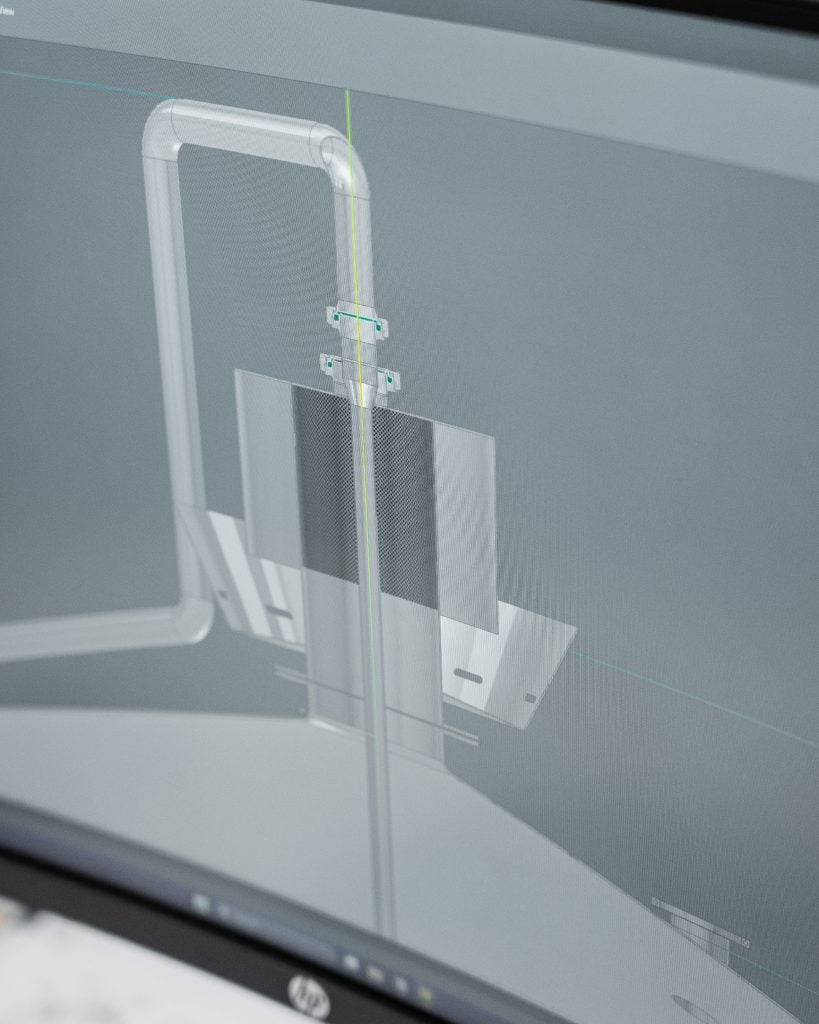
Mechanical and structural design, 3D CAD, analysis and detailed drawings, from a team that builds what it draws. Every connection detail is checked by someone who knows what it takes to weld, lift and ship it.
Designed by people who know what it takes to build it.
Our project engineers work on the same site as our production team. Subject matter experts from our production team join our engineers in methodology meetings during design, to maximise quality and minimise cost.
We take a concept to engineering-ready design: 3D models, calculations for tanks, vessels and structures, and shop drawings to the tolerances our fabricators work to. The calculations are documented, so your engineer or verifier can check every assumption.
Design for manufacture runs through this process. Plate sizes chosen to nest well, access for welding carefully planned, and lifting and transport built in from the first model.
An engineering manager and five project engineers, on the same site as the workshop that builds their designs
Independent review
CPEng
We work with independent Chartered Professional ngineers to review designs that need consent and issue the PS1.
Design and analysis
Mechanical design
Process vessels, tanks and silos, hoppers, cyclones, frames and bespoke equipment.
Structural design
Platforms, stairs, walkways, supports and skirts, with seismic and wind loading worked through.
3D CAD and CAD/CAM
Flat patterns go from the model to the Profile Centre, so cut parts match the drawing without redrawing.
Finite element analysis
Stress checks to ensure the structural integrity of the build.
Engineering calculations
Shell and head thickness, supports, hold-down bolts, lifting lugs, sheet metal and general components.
Detailing and documentation
Design for manufacture
Designs set up around real plate sizes, weld access, rolling and forming limits, to bring cost down.
Drafting
General arrangement, fabrication and shop detail drawings, with weld symbols to AS 1101.3.
Hygienic detailing
Drainability, crevice-free joints and weld finish classes to AS/NZS 1554.6 for product-contact surfaces.
Control documentation
Drawings, registers and revisions controlled to your specification and industry standards.
Accessible design
Mobility-impaired access and equipment, designed to the user’s needs.
Design verfication
When a design needs sign-off for consent, we work with independent Chartered Professional Engineers (CPEng). They review the design, and issue the relevant design producer statement your consent authority needs. You get one team managing the design, the review and the drawings.
Design conditions, loads, codes and every calculation set out, including an FEA review where one is needed.
Through our engineering partners, for Building Code work and where your specification calls for it.
Issued by the reviewing CPEng, with the drawings listed in the schedule.
Drawing revisions are tied to the design report, so what's built is what was checked.
Where a part needs proving before it goes into production, we build it and test it. Our Profile Centre cuts one-offs and short runs quickly by laser, waterjet and CNC router, so a prototype doesn’t have to wait behind a production job.
Each round of testing feeds back into the model, so the design that goes into production has already been proven in the real world.
Autodesk Inventor and Tekla, for 3D modelling, drawings and simulation. We can exchange models in neutral formats such as STEP, so you don’t need Autodesk to work with us.
We do it often. A sketch, a photo of the part that keeps failing, or a description of the problem is enough to begin. We’ll take it through to a fabrication-ready design.
An independent Chartered Professional Engineer. Our engineers prepare the design, calculations and drawings, and our CPEng partners review them and issue the PS1, PS2, or PS4 producer statement.
Yes. You can engage us for design alone, and you own the drawings. When we do build it too, the designer is on hand through fabrication to answer the workshop’s questions.
It depends on the part and the load. For tanks and silos that usually means AS 1210 or API 650 for the shell, NZS 1170.5 for seismic, AS/NZS 1170.2 for wind and AS 1657 for access. Your specification or your client’s standards take priority.
We design to AS 1210 and ASME VIII Div 1. Pressure equipment above 50 kPa also needs independent design verification under PECPR, which we arrange before manufacture.
We can. Send us the model or drawings and the loads it sees, and we’ll check stresses, suggest where material can come out or needs adding, and update the drawings to suit.